

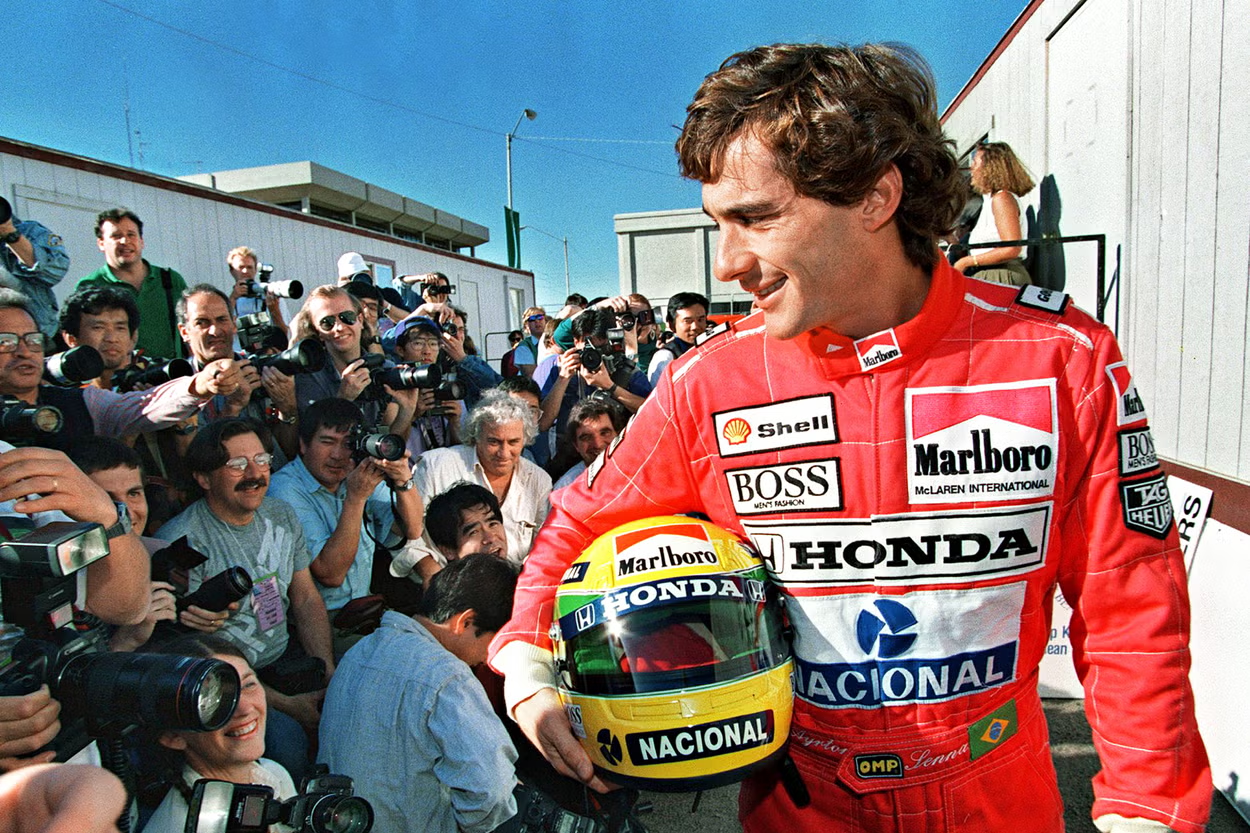
Racing did not become safe because one rule changed after Imola; it changed because the sport finally admitted talent could not outrun physics. Motorsport Safety Improvements since Ayrton Senna’s death forced teams, circuits, doctors, and governing bodies to treat every crash as evidence, not bad luck. For American fans who split weekends between Formula 1, NASCAR, IndyCar, IMSA, and local short-track racing, that shift matters because the same lesson keeps repeating: speed is allowed to grow only when protection grows with it. The modern race car is no longer built as a fast object with a brave person inside. It is built as a controlled failure machine, meant to break in planned ways while the driver’s body stays inside a protected space. That is the hard truth behind every Halo, HANS device, SAFER barrier, stronger cockpit, and faster medical response. If you follow sports industry coverage and racing culture, you can see how safety now shapes the business of motorsport as much as it shapes the engineering.
Motorsport Safety Improvements Became a System, Not a Gesture
The shock of 1994 did not create one clean answer. It created a new habit. Every wall, helmet, cockpit rim, medical car, and pit-lane rule had to face a colder question: what happens when the driver loses control at the worst possible place?
Why Imola Exposed the Old Racing Bargain
Before Senna’s fatal crash, much of racing still carried an old bargain that fans rarely said out loud. Drivers accepted danger. Fans admired nerve. Organizers made changes when pressure became too loud to ignore. That bargain had history, romance, and courage inside it, but it also gave the sport a hiding place.
Imola stripped away that hiding place. Roland Ratzenberger died during qualifying. Senna died the next day. Rubens Barrichello had already suffered a heavy crash earlier that weekend. This was not one strange accident sitting alone. It felt like a whole safety model breaking in public.
The first response had to be blunt. The FIA reviewed high-risk corners, forced circuit changes, tightened tyre barrier rules, reduced pit-lane speeds, and pushed tougher helmet standards. That sounds procedural, almost dry. It was not dry at all. It meant the sport had accepted that bravery could no longer be the main safety plan.
How F1 Safety Technology Turned Crashes Into Data
The deeper change came when F1 safety technology stopped being only about stronger parts. It became about proof. Survival cells began carrying data recorders. Cockpit sides rose. Headrests grew. Roll hoops faced tougher tests. The car became a witness after every crash.
That matters because racing people can argue over opinions forever. Data is harder to charm. When sensors show impact force, head motion, timing, speed, and deceleration, the debate changes. The question becomes less personal. It becomes measurable.
A modern crash investigation now looks at the car, the barrier, the driver’s equipment, the track, the weather, the rescue window, and the way race control reacted. That layered review is the quiet reason racing looks safer today. Not because danger left. Because the sport became less willing to shrug.
The Car Became a Survival Cell Before It Became Faster
Once the sport accepted that crashes needed to be studied, the car itself had to change. The driver could no longer sit inside a fast machine that hoped to stay whole. The machine had to sacrifice itself while the cockpit stayed loyal.
Driver Survival Systems Moved the Injury Line
Driver survival systems changed the meaning of a “bad hit.” Years ago, a crash that left the car torn apart often told you enough. Today, a shredded car can be a sign that the outer structure did its job. That can feel backward the first time you see it.
The HANS device is the clearest example. It does not make a car stronger. It controls how the head and neck move when the body stops faster than the brain expects. NASCAR’s adoption after Dale Earnhardt’s death pushed the American racing audience to accept something many drivers had resisted. Comfort lost the argument. Survival won.
F1 made HANS mandatory in 2003, and wider FIA adoption followed. That timing shows a hard pattern in racing safety. A device can exist for years before the culture is ready to accept it. The invention is one battle. The habit is another.
Why Head Protection Changed the Look of Open-Wheel Racing
Open-wheel racing protected the driver’s body long before it fully protected the driver’s head. That weakness sat in plain sight. Fans loved the open cockpit because it looked pure. Drivers loved visibility and tradition. The danger was part of the shape.
The Halo broke that visual contract. When Formula 1 introduced it in 2018, some fans said the cars looked wrong. Some drivers had doubts too. Then came crashes where the device made the argument better than any engineer could. Lewis Hamilton at Monza in 2021. Zhou Guanyu at Silverstone in 2022. The debate did not vanish, but it lost its sharpest edge.
IndyCar took a different route with the Aeroscreen, blending a titanium frame with a ballistic screen. That choice fits American open-wheel racing, where ovals, street circuits, and high-speed traffic can send debris into ugly paths. The counterintuitive part is that adding protection can create new problems, including heat, airflow, and visibility work. Safety never arrives finished. It arrives as a draft that gets tested at speed.
The Track Had to Share Responsibility for the Crash
The car can protect only so much if the track turns every mistake into a direct hit. That is why the safety story after Senna cannot be told from the cockpit alone. Walls, runoffs, gravel traps, barriers, kerbs, fencing, and recovery zones became part of the driver’s equipment.
Why Racing Crash Protection Had to Move From Car to Circuit
Racing crash protection changed when engineers stopped treating the wall as fixed scenery. A concrete wall keeps cars away from spectators, but it gives the driver little mercy. A barrier that absorbs energy buys time, and in a crash, time is life measured in fractions.
The SAFER barrier is the American example that still deserves attention. Developed through work tied to the University of Nebraska-Lincoln, Indianapolis, IndyCar, and NASCAR, it added energy absorption to oval walls that once punished drivers with brutal force. At Indianapolis Motor Speedway and later NASCAR tracks, the wall became less of a final sentence.
That does not mean every track is equal. A national series can push expensive upgrades. A local oval in the Midwest may fight cost, space, and old habits. This is where safety gets uncomfortable. The technology exists in one place before it reaches another. A Saturday night racer can still face risks that television makes easy to forget.
What NASCAR and IndyCar Added to the American Safety Lesson
American racing learned its own version of the post-Imola lesson through grief. Dale Earnhardt’s 2001 Daytona 500 crash changed NASCAR’s relationship with head-and-neck restraints. The sport that once sold toughness as identity had to admit that restraint systems were not weakness. They were equipment for grown professionals.
NASCAR also learned that heavy stock cars and high-banked ovals demand their own answers. A Formula 1 survival cell does not solve Daytona. A road-course runoff does not solve Bristol. That is why a deeper look at American motorsport culture needs to include safety design, not only rivalries and trophies.
IndyCar sits in the middle. It has open wheels, high speed, street races, road courses, and ovals. The Aeroscreen reflects that mixed threat. It protects the cockpit from debris while adding heat and airflow challenges that engineers continue to refine. The lesson is plain: no series copies another series perfectly. Each form of racing has to respect its own danger.
The Next Risk Is Heat, Debris, and the False Calm After Progress
Safety progress can trick people into thinking the hardest work is done. That is the wrong lesson. Modern racing is safer because it keeps finding new weak points after old ones are repaired.
Why Cockpit Data Now Matters Before the Medical Car Arrives
Modern medical crews do not wait only for a driver to speak over the radio. Biometric gloves, in-ear accelerometers, high-speed cockpit cameras, and crash data give doctors more clues before hands reach the car. That changes the first minute after impact.
A driver may say, “I’m fine,” because adrenaline lies well. Data can disagree. Heart rate, oxygen levels, head movement, and impact readings help medical teams decide whether to extract slowly, act fast, or prepare for hidden injury. That is not cold science replacing human judgment. It is human judgment getting better tools.
Romain Grosjean’s 2020 Bahrain crash showed how far the sport had come and how much remained exposed. The survival cell, Halo, clothing standards, marshals, and medical response all mattered. So did fire, barrier behavior, fuel system questions, and escape time. One crash became many lessons.
What Fans Should Notice When Danger Looks Controlled
The danger in modern racing often looks cleaner on television. Cars break apart in planned ways. Drivers climb out. Replays come with calm analysis. That can make risk feel smaller than it is.
You should watch the small details. Notice how fast marshals arrive. Notice whether the car slides along a barrier or stops dead. Notice if a wheel stays tethered. Notice how race control slows the field. Notice whether the driver exits alone or waits for help. Those details tell the safety story better than a dramatic replay.
There is also a business angle. Series that want younger fans, family audiences, and long-term sponsors cannot sell avoidable tragedy. The next generation of safety will affect streaming deals, insurance, event planning, and grassroots participation. A parent deciding whether a teenager can race karts in Texas or Florida may never read an FIA report, but that parent is living with the outcome of those reports.
Conclusion
The best safety work in racing has never been sentimental. It is stubborn, technical, and sometimes unpopular at first. The lesson after Senna is not that motorsport found a way to remove danger. It is that danger must now answer to evidence. Motorsport Safety Improvements turned grief into inspection, inspection into rules, and rules into machines that fail with more mercy. That is why the modern driver can survive crashes that once felt unsurvivable, from Formula 1 to NASCAR to IndyCar. Fans should not confuse that progress with comfort. The next weak point is always waiting: a hotter cockpit, a sharper barrier angle, a loose wheel path, a delayed warning, a local track without enough money. Racing earns its future only when it keeps asking the hardest question after every escape: why did the driver live, and how do we make that answer repeatable? Keep watching the speed, but pay attention to the systems that let people walk away.
Frequently Asked Questions
Did Ayrton Senna’s death directly change racing safety rules?
Yes, but not through one single rule. His death, along with Roland Ratzenberger’s fatal crash at the same Grand Prix weekend, pushed the FIA into deeper circuit reviews, cockpit changes, helmet standards, medical planning, and a new habit of treating crashes as evidence.
What safety changes happened first after the 1994 San Marino Grand Prix?
Early changes focused on circuit risk, barrier standards, pit-lane speed limits, helmet rules, and car performance controls. The goal was to reduce exposure at dangerous corners while also improving how cars and tracks handled high-speed impacts.
How did the HANS device improve driver safety?
The HANS device limits violent head and neck motion during a crash. That matters because the torso is held by belts while the helmeted head wants to keep moving. By controlling that motion, it helps reduce deadly neck and skull-base injuries.
Why did F1 introduce the Halo?
The Halo was introduced to protect drivers from large debris, car-to-car contact, and cockpit intrusion. Open cockpits left the head exposed for decades. Later crashes showed why the device mattered, even for fans who disliked its appearance at first.
What is the SAFER barrier in NASCAR and IndyCar?
The SAFER barrier is an energy-absorbing wall system made to reduce impact force when cars hit oval-track walls. Instead of a car meeting bare concrete, the barrier spreads and absorbs energy, giving the driver a better chance of surviving a heavy crash.
Are modern race cars safer than older ones?
Yes, in professional series, modern cars protect drivers better through survival cells, head restraints, tethers, stronger helmets, fire protection, and data systems. That does not make racing safe. It means more crash energy is managed before it reaches the driver.
Why do safety rules often change after major crashes?
A major crash exposes weak points that testing may miss. Racing is too complex for every danger to appear in a lab. When a real incident reveals a failure path, engineers and rule makers can redesign cars, tracks, equipment, or procedures.
Does better safety make motorsport less exciting?
No. Better safety lets drivers race hard without forcing the sport to rely on needless risk. Fans still get speed, pressure, skill, and close fights. The difference is that the sport no longer treats preventable injury as part of the show.